
Nancy Grace Roman Telescope Prepares for August 30 Launch
NASA's Nancy Grace Roman Space Telescope is set for launch on August 30, 2026, aboard a SpaceX Falcon Heavy rocket. The observatory will investigate dark energy, exoplanets, and distant stars.

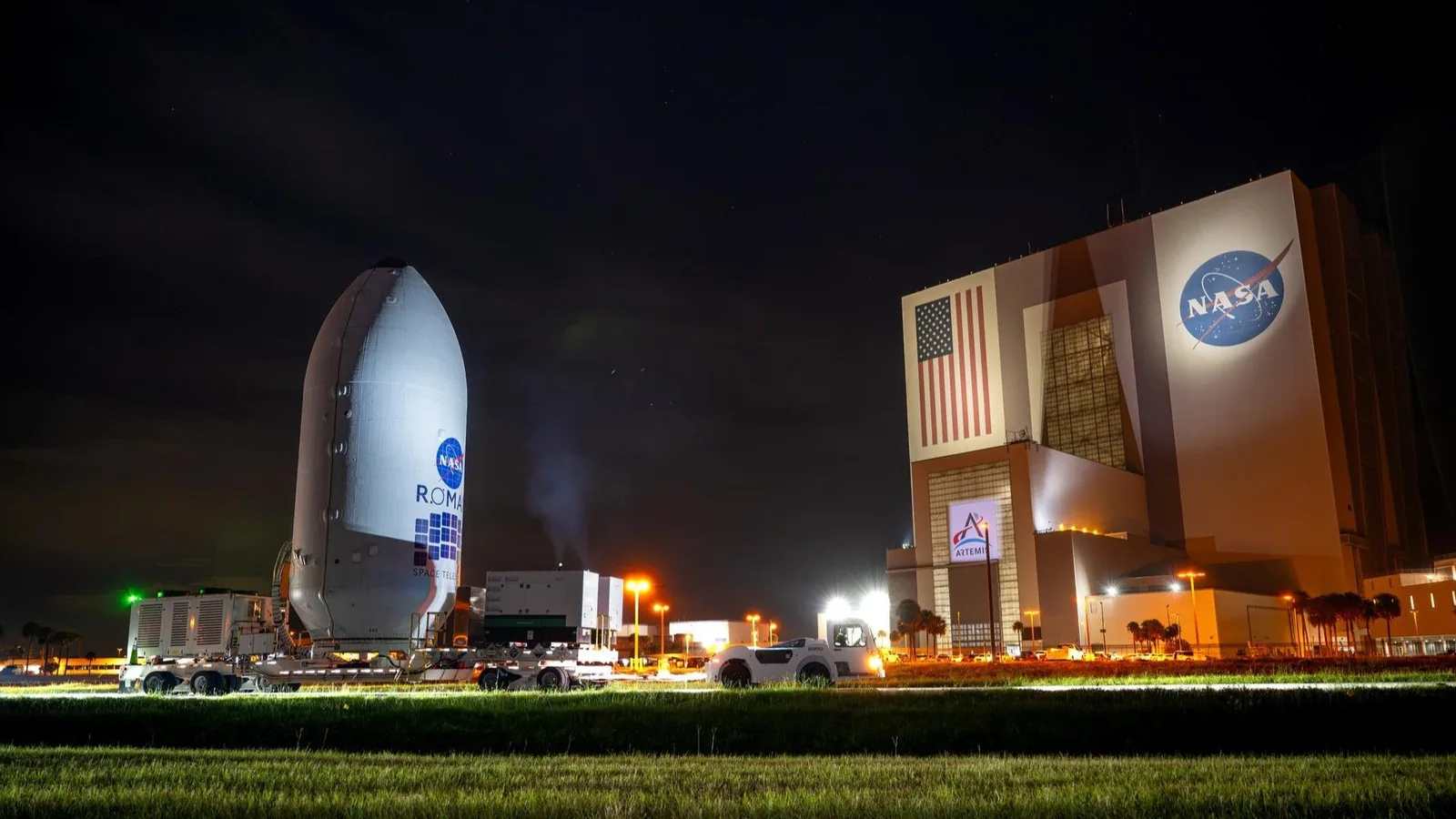
NASA's next-generation space observatory, the Nancy Grace Roman Space Telescope, is on the cusp of its journey to unlock cosmic mysteries. Scheduled for liftoff no earlier than 7:26 a.m. EDT on Sunday, August 30, 2026, Roman will launch from NASA's Kennedy Space Center in Florida aboard a powerful SpaceX Falcon Heavy rocket. This mission marks a significant step in astronomical exploration, aiming to shed light on dark energy, discover exoplanets, and study the physics of distant stars.
SpaceX recently provided a glimpse of the formidable Falcon Heavy rocket that will carry the Roman telescope into orbit. The launch vehicle, characterized by its three strapped-together Falcon 9 boosters forming the first stage, is currently housed in a hangar at Launch Pad 39A at the Kennedy Space Center. This mission represents a crucial collaboration between NASA and SpaceX, combining NASA's scientific ambition with SpaceX's launch capabilities.
The Roman telescope itself has undergone critical pre-launch preparations. It was transported overnight on August 25 from the Kennedy Space Center's Payload Hazardous Servicing Facility to SpaceX's hangar at Launch Complex-39A. Following this move, the observatory, enclosed within its protective fairings, will be mated to the Falcon Heavy rocket. Extensive fit checks and final tests are scheduled before the rocket is rolled out to the launch pad.
Final Checks and Launch Readiness
A critical Launch Readiness Review is slated for Friday, August 28, 2026, where NASA and SpaceX officials will convene to make the final determination on launch readiness. Assuming all systems perform as expected, the launch will proceed towards the targeted Sunday morning departure. This rigorous review process ensures the safety and success of the mission, a testament to the complex engineering and meticulous planning involved.
Following its encapsulation within the Falcon Heavy's payload fairing, the Roman telescope has also completed a full launch-day dress rehearsal on August 20, 2026. Prior to this, technicians successfully loaded the observatory with 290 gallons (1,100 liters) of hydrazine fuel on July 25, and it was attached to its payload adapter in early August. The mission's Flight Readiness Review was formally completed on August 21, officially clearing the observatory for its final launch preparations.
Once in space, the Roman telescope will embark on a journey of approximately 30 days to reach its operational orbit at the Sun-Earth Lagrange Point 2 (L2). This gravitationally stable point is located about 930,000 miles (1.5 million kilometers) from Earth. Following a subsequent three-month checkout period, the telescope will commence its scientific operations, beginning its ambitious quest to unravel some of the universe's most profound enigmas, including the nature of dark energy and the composition of distant planetary systems.
The Nancy Grace Roman Space Telescope is poised to become NASA's next great observatory, building upon the legacy of missions like the Hubble Space Telescope and the James Webb Space Telescope. Its wide field of view, significantly larger than Hubble's, will enable it to survey vast areas of the sky efficiently. This capability is essential for its primary science goals: measuring the expansion history of the universe to understand dark matter and dark energy, and conducting a census of exoplanets, searching for Earth-like worlds. The telescope's design also includes a coronagraph instrument, which will enable direct imaging of exoplanets, a feat that promises to revolutionize our understanding of planetary formation and the potential for life beyond our solar system. The development and upcoming launch of the Nancy Grace Roman Space Telescope represent a monumental achievement in space science and a beacon of hope for future astronomical discoveries.