
ISS Astronauts Complete 100th US Spacewalk, Deploying New Solar Array
Two astronauts successfully completed the 100th spacewalk by a U.S. crew on the ISS, deploying a new solar array. This milestone signifies a major step in upgrading the station's power capabilities.

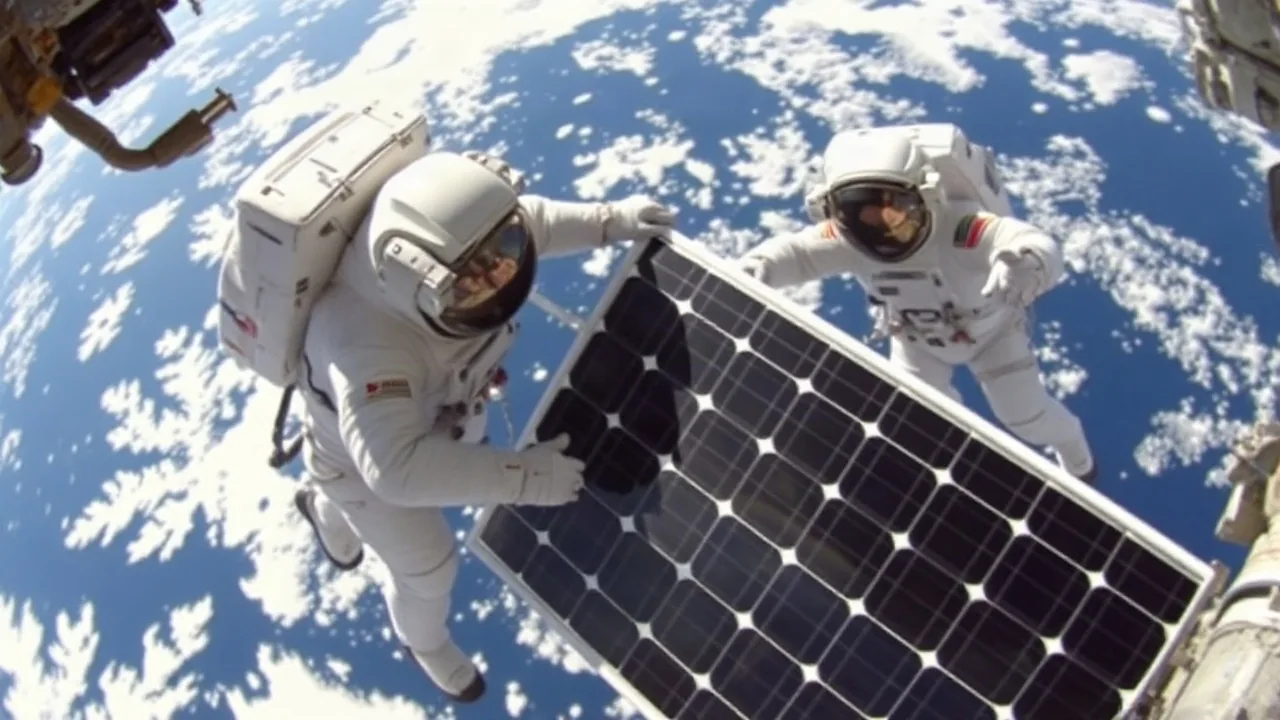
The International Space Station (ISS) marked a significant milestone on October 26, 2026, as astronauts completed the 100th spacewalk conducted by a U.S. crew. This landmark Extravehicular Activity (EVA) involved the deployment of a new, advanced solar array designed to significantly boost the station's power generation capabilities. The operation, which lasted several hours, was executed flawlessly by NASA astronauts Commander Jessica Meir and Flight Engineer Victor Glover.
The new solar array is part of a multi-year effort to upgrade the ISS's aging power system. The station currently relies on older arrays that have been in operation for over two decades. These new roll-out solar arrays, known as the International Space Station Solar Array (ISSA), are more efficient and designed to provide increased power output, essential for supporting the station's scientific research and operations well into the future.
Powering Future Research
The successful deployment is a critical step in ensuring the ISS remains a fully functional orbiting laboratory. Increased power is vital for the numerous experiments being conducted on the station, many of which require substantial energy. Projects ranging from materials science and human physiology to astrophysics and Earth observation will benefit from the enhanced power supply. The ISSA technology itself is a scaled-down version of arrays intended for future lunar and Martian surface power systems, serving as a valuable testbed for deep space exploration technologies.
During the spacewalk, Meir and Glover navigated the exterior of the Zvezda service module, carefully unfurling the compact solar array. The process required precise coordination and adherence to strict safety protocols, as is standard for all EVAs. Mission control in Houston, Texas, provided constant guidance and monitoring throughout the operation. "This was a complex maneuver, but the team executed it with incredible precision," stated NASA spokesperson Dr. Thomas Zurbuchen. "It's a testament to the dedication and expertise of our astronauts and the ground support teams."
The 100th U.S. spacewalk highlights the enduring international collaboration that defines the ISS. Since its initial assembly began in 1998, the station has served as a unique platform for scientific discovery and technological advancement. This latest upgrade underscores the commitment of the United States and its international partners to maintaining and enhancing the capabilities of this vital orbital outpost. The mission also saw the astronauts perform minor maintenance on other external components of the station, ensuring its continued operational readiness.