
Gemini North Telescope Captures Star's Crystal Ball Nebula
The Gemini North Telescope has captured a stunning image of the Crystal Ball Nebula, a dying binary star system 1,500 light-years away. The nebula's glowing gas cloud resembles a celestial crystal ball.

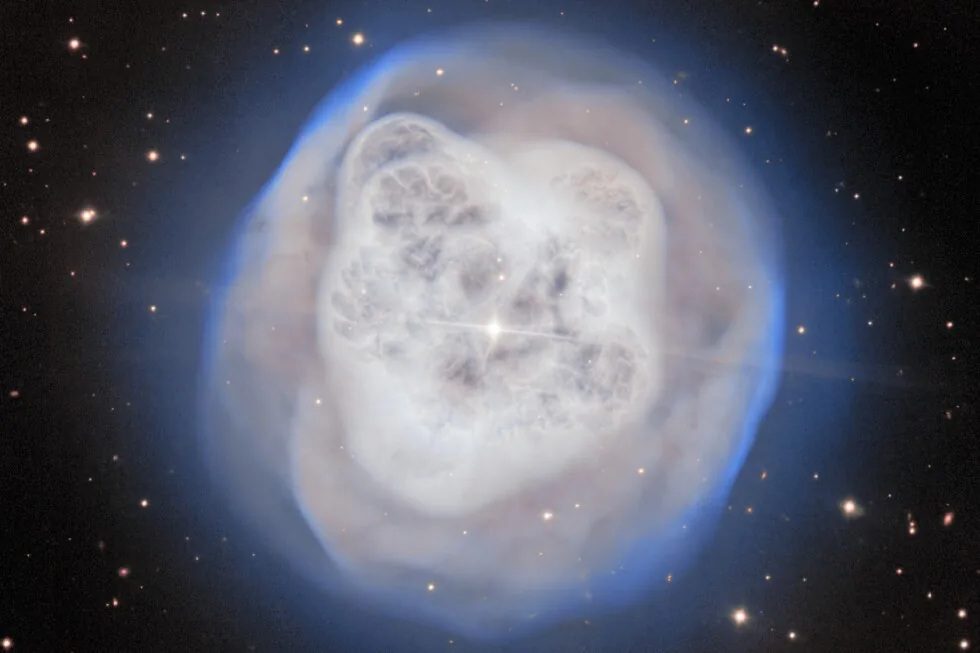
The Gemini North Telescope has captured a breathtaking image of a dying binary star system, nicknamed the Crystal Ball Nebula, located approximately 1,500 light-years from Earth. The striking photograph, released Thursday by the National Science Foundation's NOIRLab, showcases the nebula's ethereal, milky white spherical cloud surrounding the star system.
This celestial phenomenon occurs when a star nears the end of its life and sheds its outer layers. The exposed stellar core then heats this expelled gas to extreme temperatures, causing it to emit a brilliant, otherworldly glow. The nebula, formally cataloged as NGC 1514, is composed of two stars orbiting each other. Scientists believe one of these stars, which was once larger than our sun, has reached its final stages.
Observations of the nebula were conducted by the Gemini North telescope, situated atop Mauna Kea, Hawaii's tallest peak, last year. The final image, processed to display its full colors, was completed and released this week. A light-year, the unit used to measure these vast cosmic distances, is equivalent to nearly 6 trillion miles.
Cosmic Beauty and Scientific Insight
The image of the Crystal Ball Nebula highlights the intricate and often beautiful processes that occur at the end of a star's life. Studying such planetary nebulae provides astronomers with crucial insights into stellar evolution and the eventual fate of stars, including our own Sun. The detailed observations made by instruments like the Gemini North telescope allow scientists to analyze the composition and temperature of the gas clouds, as well as the characteristics of the stars within.
Understanding the life cycles of stars is fundamental to astrophysics. It helps explain the origins of elements heavier than hydrogen and helium, which are forged in the hearts of stars and dispersed into space when they die. These elements then form new stars, planets, and potentially, life. The clarity of the new image is expected to facilitate further research into the specific mechanisms driving the formation of nebulae like NGC 1514 and the dynamics of binary star systems.
NOIRLab, which manages the Gemini Observatory, operates both the Gemini North telescope in Hawaii and its sister telescope, Gemini South, in Chile. These powerful observatories are equipped with advanced instruments capable of observing the universe in unprecedented detail, pushing the boundaries of astronomical discovery. The data collected contributes to a broader understanding of the cosmos and humanity's place within it.