
Anil Menon: Indian-Origin Astronaut Conducts First ISS Spacewalk
NASA astronaut Anil Menon, of Indian heritage, completed his inaugural 6.5-hour spacewalk outside the International Space Station on Thursday. He worked with Jessica Meir to upgrade the station's power system.

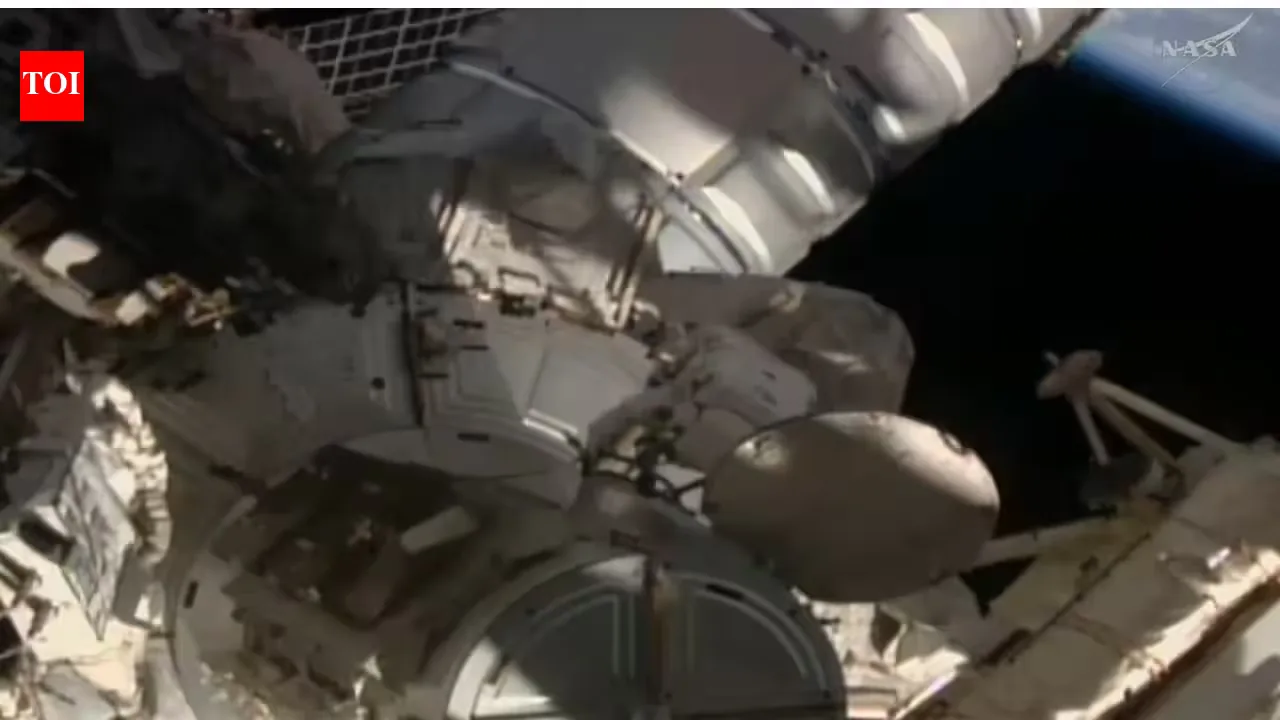
Indian-origin NASA astronaut Anil Menon made his debut spacewalk on Thursday, venturing outside the International Space Station for a 6.5-hour mission to upgrade the orbiting laboratory's power systems. This marks a significant personal milestone for Menon and a continued expansion of India's presence in space exploration.
Menon, a physician and former flight surgeon, teamed up with veteran NASA astronaut Jessica Meir for the Extravehicular Activity (EVA). Their primary objective was to install hardware on the station's 3B power channel, preparing for the installation of another International Space Station Roll-Out Solar Array (IROSA) later this year. This new panel will be the seventh IROSA, significantly boosting the ISS's electricity generation capacity for scientific experiments and life support.
Upgrading the ISS for Future Operations
The spacewalk is part of NASA's broader strategy to extend the ISS's operational lifespan and prepare for its eventual de-orbit in the next decade. The existing solar arrays, in operation for over two decades, have shown degradation due to the harsh space environment. The new, more efficient IROSAs offer substantially greater power output compared to the older panels. By installing this mounting hardware now, astronauts are laying the groundwork for future upgrades without disrupting ongoing station activities.
Anil Menon, selected by NASA in 2021, brings a unique background to his role as an astronaut. His expertise as a physician and mechanical engineer, coupled with his experience as SpaceX's first flight surgeon, has been crucial. Born in the U.S. to an Indian father and Ukrainian mother, Menon is a prominent figure representing NASA, continuing a legacy of astronauts with Indian roots in space exploration.
Spacewalks are among the most demanding tasks in human spaceflight. Every action, from tool handling to movement, requires meticulous planning and coordination with mission controllers. Astronauts operate in the vacuum of space, facing extreme temperature fluctuations and speeds of approximately 28,000 km/h.
The mission, designated US Spacewalk 96, is the 281st spacewalk in support of the ISS. It is also the first of three NASA spacewalks scheduled for August 2026. Future EVAs will focus on replacing a communications antenna and upgrading data relay systems. Throughout the operation, Menon and Meir utilized NASA's Extravehicular Mobility Unit (EMU) spacesuits, designed to provide oxygen, temperature control, and protection from radiation and micrometeoroids. Both astronauts were secured by multiple safety tethers.
For India, Menon's spacewalk holds particular significance as the nation pursues its own human spaceflight ambitions with the Gaganyaan program. His accomplishment echoes the contributions of previous Indian-origin astronauts like Kalpana Chawla and Sunita Williams, inspiring a new generation in space exploration.