
Telepathic Instruments Orchid: A Modern Take on Vintage Chord Organs
The Telepathic Instruments Orchid revives the charm of vintage chord organs, offering an accessible way for musicians to create rich harmonies. Designed with input from Tame Impala's Kevin Parker, it blends retro aesthetics with digital flexibility.

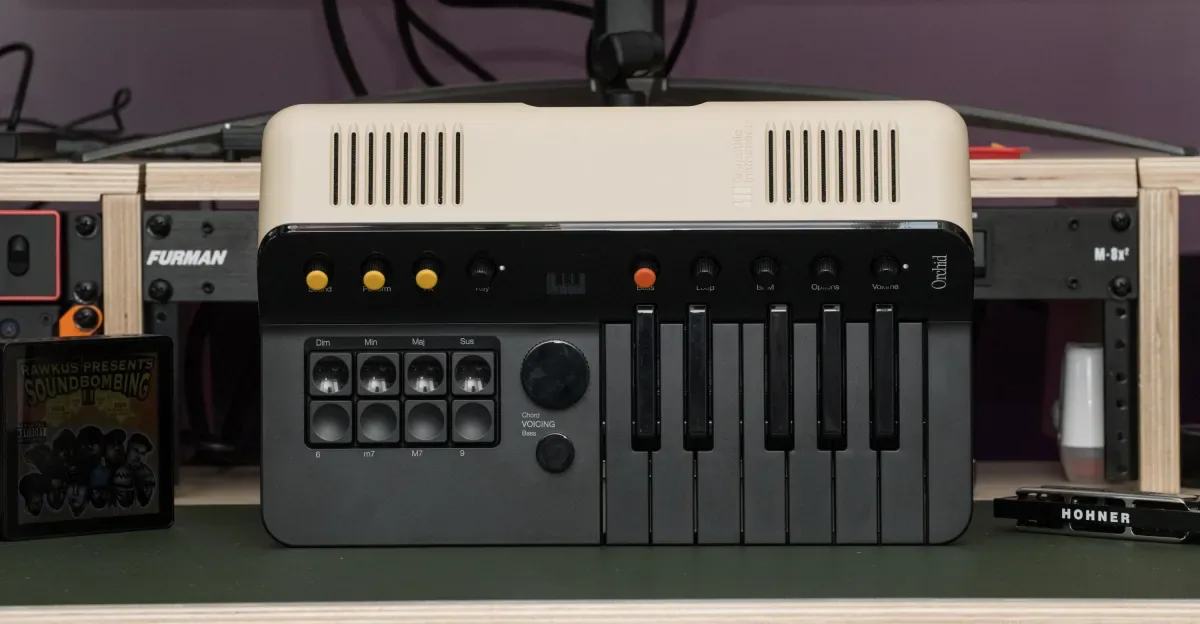
The Telepathic Instruments Orchid revives the accessible magic of vintage electric chord organs, allowing musicians to craft full chord progressions with minimal effort. Launched in 2026, this digital instrument, designed in collaboration with Kevin Parker of Tame Impala, offers a retro aesthetic reminiscent of 1960s Magnus and Bontempi organs, combined with modern digital capabilities.
Unlike their analog predecessors, which were limited by physical reeds, the Orchid is fully digital and can theoretically produce any chord in any voicing or scale. This digital flexibility means the instrument can generate a far wider range of sounds than traditional chord organs, moving beyond the characteristic drone. For songwriters, especially those who find it challenging to sing and play simultaneously, the Orchid can significantly reduce the mental load by handling harmonic accompaniment. This allows creators to focus more intently on lyrical and vocal melodies.
The instrument features a single-octave keyboard and a bank of buttons to the left, enabling users to select chord types such as major, minor, diminished, and seventh chords. For instance, pressing 'C' and the 'major' button produces a C major chord. The Orchid can also simplify the creative process by locking to a specific key, such as E minor or B-flat major, ensuring that nearly any combination played sounds harmonically pleasing. This feature is particularly beneficial for musicians with limited formal music theory knowledge, expanding their sonic possibilities with reduced frustration.
Expanding Harmonic and Sonic Possibilities
Beyond basic chord playing, the Orchid incorporates several performance modes, including strum, harp, and arpeggiator functions, alongside 13 pre-programmed patterns. A standout feature is the "slop" mode, which introduces subtle timing imperfections to mimic human performance, making the instrument feel more organic. The built-in drum machine, inspired by 1970s rhythm machines like the Korg Mini Pops, offers a collection of lo-fi, charmingly dated beats.
Underneath its retro facade, the Orchid houses three distinct digital sound engines: a virtual analog synth for broad sound design, an FM synth for classic 1980s electric piano and bell tones, and a reed piano engine capable of emulating Wurlitzer and Rhodes sounds. These engines allow for a diverse sonic palette, from ambient pads suitable for creative noodling to foundational elements for tracks. While the instrument comes with 70 presets, direct sound customization on the Orchid itself is limited. Users can adjust parameters like filter cutoff and effect intensity, but for deep sound design, an additional purchase of the $99 Pistil virtual synth software is required. Although bundled with the Orchid, Pistil can sometimes be buggy according to initial reports.
The Orchid also includes a separate bass section with 12 distinct sounds, ranging from deep electric piano tones to Moog-style synth basses and 808-inspired drums. These bass sounds can be layered with the main keyboard sounds or used independently. While the Orchid's polyphony limitations mean that playing chords can sometimes cut off sustained notes, its built-in audio looper provides a flexible solution for recording and layering chord progressions, basslines, and melodies separately.
Despite its limitations, such as the inability to play full chords on the keyboard itself and the reliance on external software for advanced sound creation, the Telepathic Instruments Orchid offers a unique blend of retro charm and modern functionality. It stands as an approachable tool for musicians looking to simplify harmonic creation, experiment with diverse sounds, and inject a dose of vintage character into their music production workflows.