
Framework Laptop 13 Pro: Enhanced Battery Meets Higher Cost
Framework's latest modular laptop, the Laptop 13 Pro, introduces significant battery life improvements and a more polished design. However, these upgrades come with a considerably higher price tag.

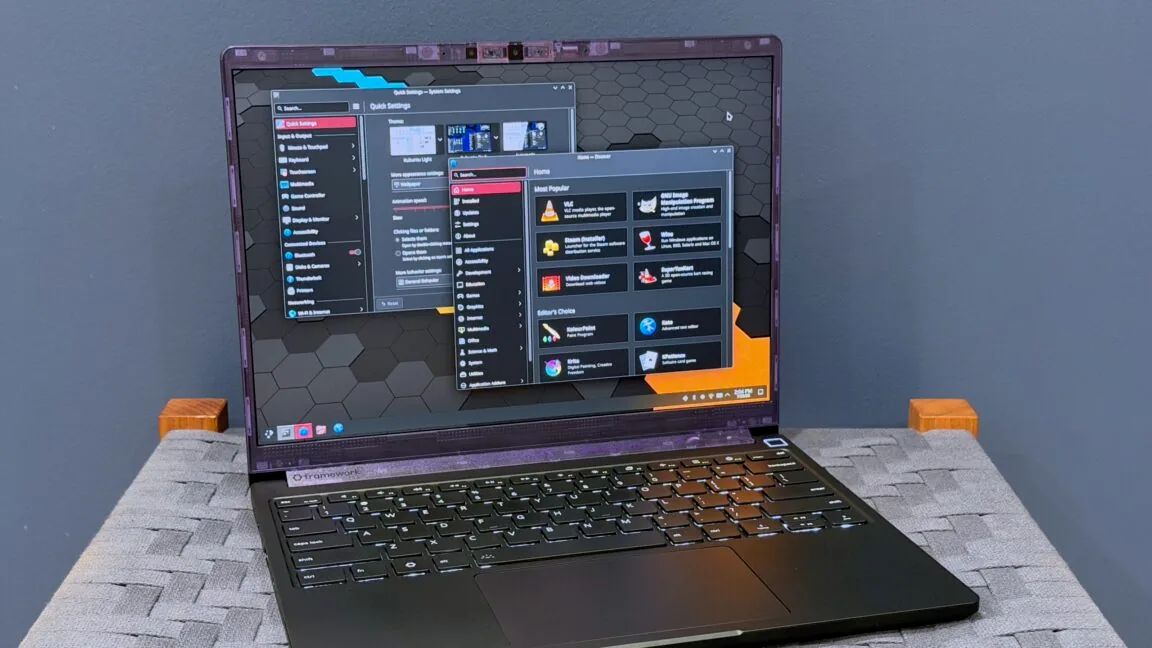
The Framework Laptop 13 Pro has arrived, marking a notable evolution for the company's highly repairable and upgradeable modular laptop. While previous iterations offered incremental changes, the Laptop 13 Pro represents a more substantial revision, bringing enhanced battery life and a refined aesthetic. This update, however, introduces a significant increase in cost, positioning it as a premium option in the current tech market.
Framework's newest offering adopts a sophisticated "graphite" anodized aluminum finish, a departure from its signature silver. This deep gray, similar to Apple's Midnight finish but with less of a blue tint, does tend to attract fingerprints. While upgrade parts are available in the original aluminum for existing Laptop 13 owners, the Pro model is primarily machined from solid blocks of 6063 aluminum, contributing to a more robust and substantial feel. This redesign also accommodates a larger 74 WHr battery, an upgrade from the 55 WHr and 61 WHr options in earlier models, directly addressing a long-standing critique of mediocre battery performance.
Key design adjustments include a revised expansion module release mechanism, now featuring on/off retention switches similar to those found on the Laptop 16 and 12. The keyboard retains its familiar feel but offers new keycap highlight options in lavender or orange/gray. More significantly, the trackpad has transitioned to a haptic system, simulating clicks through vibrations, a move necessitated in part by the larger battery. While not as tactile as a physical click, the haptic feedback, especially with firmness set high, provides a consistent response across the entire surface.
The 13.5-inch display also sees improvements. It maintains its 2,880×1,920 resolution, 3:2 aspect ratio, and 30 to 120 Hz refresh rate, but now includes touch support. This is Framework's first touchscreen display, boasting a brighter 700 nits typical brightness, an 1,800:1 contrast ratio, and an updated anti-glare coating. These enhancements offer marginal but noticeable benefits, particularly for users upgrading from older, lower-resolution screens. However, the display still lacks OLED technology and full DCI-P3 color gamut coverage, and minor light bleed was observed on the review unit.
A Shift Towards Premium Positioning
Framework is now positioning the Laptop 13 Pro as a potential "MacBook Pro for Linux users," even offering Ubuntu 24.04 LTS as a preinstalled option on its prebuilt configurations. While it fully supports Windows 11, the emphasis on Linux is clear. Framework has a history of strong Linux support, with official compatibility for Ubuntu and Fedora, and an improving system for BIOS updates via LVFS. The company recommends Linux kernel version 6.19 or higher for optimal support of Intel's Core Ultra Series 3 chips, with kernel 7.0+ preferred.
Internally, the core board now utilizes LPDDR5X memory in the LPCAMM2 form factor, replacing the previous DDR5 SO-DIMMs. This new module design uses screws to secure the RAM and a metal piece that acts as both a heat spreader and electromagnetic interference shield, reportedly enhancing wireless performance. This single-module setup simplifies memory configuration but means users cannot opt for dual-channel configurations by using matched pairs, a trade-off for the new form factor's advantages.
Despite these advancements, the Laptop 13 Pro's most significant hurdle is its price. No configuration falls below $1,500, with the top-tier review unit reaching nearly $3,000 in 2026. This positions the Laptop 13 Pro as a considerably more expensive device than its predecessors, even within the context of the current high-priced consumer electronics market. The improved battery and build quality are substantial, but the steep price point will likely be a major consideration for potential buyers.