
Bumblebees Exhibit Spontaneous Problem-Solving Skills, New Study Reveals
Bumblebees can spontaneously solve complex tool-use puzzles without prior training, according to a new study published in Science. This marks the first demonstration of such insight-driven problem-solving in insects.

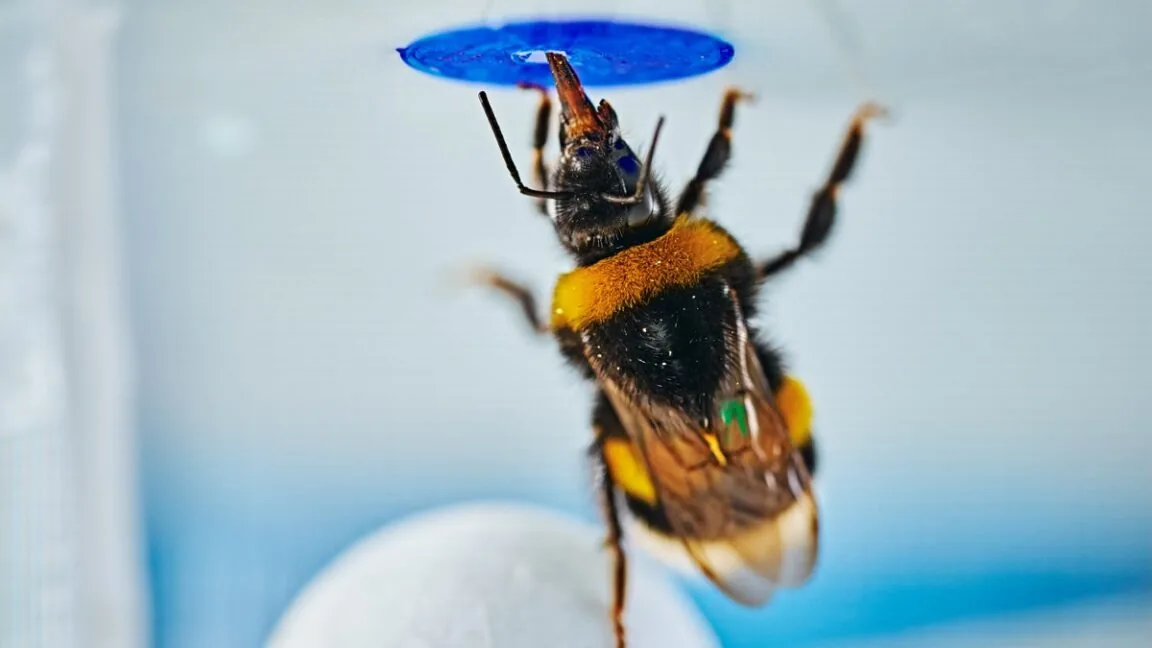
Bumblebees, despite their small brains, have shown a remarkable capacity for solving complex problems spontaneously, according to a groundbreaking study published in the journal Science this year. Researchers observed insects successfully completing object-manipulation tasks that required using tools to reach a reward, without any prior training or reinforcement. This finding represents the first documented instance of such spontaneous problem-solving abilities in an insect species.
The study, led by Olli Loukola from the University of Finland, built upon previous research from 2024 that demonstrated bumblebees could engage in cooperative problem-solving. In earlier experiments, pairs of bees were trained to push a Lego block or a door to access a sugary reward. Loukola and his team noticed that bees were more inclined to participate in these tasks when their partners were also involved, suggesting potential intentional cooperation. However, this latest research aimed to investigate whether bees could devise solutions to novel problems independently.
The first experimental setup involved an artificial flower positioned above a pit, making it impossible for a bee to hover and reach. To access the reward, a bee needed to roll a small ball into the pit and then climb onto it. This task is akin to the classic "box-and-banana" problem observed in mammals, requiring the animal to understand that an object can be used as a tool to overcome an obstacle.
Investigating Insight and Tool Use
To assess spontaneous problem-solving, researchers tested three groups of bees. One group was trained to recognize the artificial flower as a reward source and that the ball could be moved, but they received no direct instruction on using the ball as a tool. A second group learned about the flower's reward but not about the ball's movability, and a third control group received no training whatsoever. The first group, which had learned the properties of the individual elements, demonstrated significantly higher success rates in solving the puzzle compared to the other two groups. These trained bees also showed more attempts and interacted with the ball in a more structured manner.
Further experiments were designed to isolate the bees' innate problem-solving capabilities from potential reward-seeking behaviors or simple trial-and-error. In one variation, a barrier was placed to partially obscure the bees' view of the flower, requiring them to roll the ball through an opening to proceed. This setup tested whether bees could solve the task without continuous visual feedback from the goal. Of the 22 bees tested, 16 successfully completed the task. In a subsequent modification, the barrier featured three openings to further limit visual cues, and performance between trained and untrained bees remained similar, suggesting that learning the specific reward source was less critical than understanding the tool's function.
In a final experiment, the researchers aimed to eliminate accidental successes and external visual cues entirely. Bees were trained to associate a flower with a reward in one of two unseen compartments. During the test, the flower was hidden from the ball's starting position, requiring bees to move the ball into the correct compartment. A significant majority, 23 out of 30 bees, succeeded, with many doing so directly without first placing the ball in the wrong compartment. While the study could not precisely pinpoint the exact moment of insight, these results provide compelling evidence that bumblebees can generate novel, goal-directed solutions. The findings lay the groundwork for future investigations into the cognitive processes underlying insight in insects, challenging previous assumptions about insect intelligence. The research highlights the complex cognitive abilities that can exist even in small nervous systems, a critical area of study in animal cognition and insect intelligence.