
AI Sports Analytics Predicts NFL 2026 Game Outcomes
Advanced artificial intelligence models are now forecasting NFL game results with unprecedented accuracy in 2026, reshaping how teams prepare strategies and evaluate player performance.

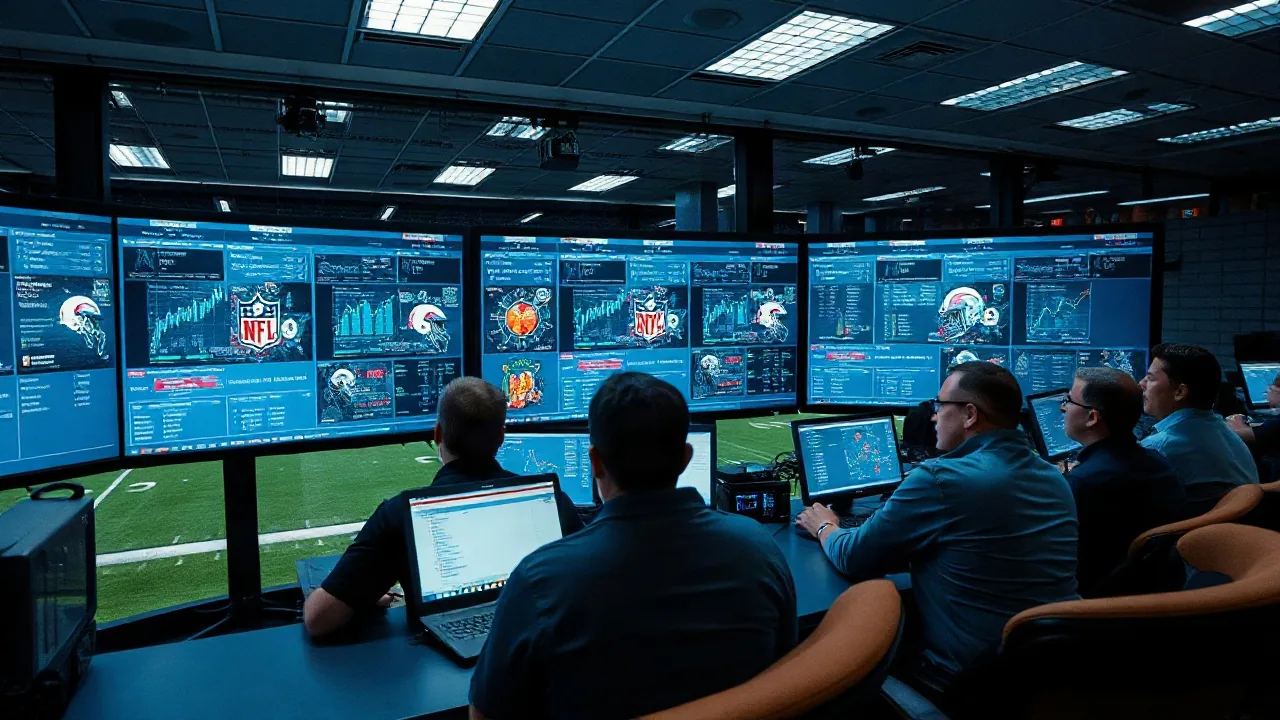
The Kansas City Chiefs' coaching staff gathered around a bank of monitors on October 15, 2026, watching real-time predictive models calculate win probabilities before kickoff. The system, powered by machine learning algorithms trained on eight seasons of play-by-play data, had flagged a defensive vulnerability in the opposing offense that human scouts had missed. This scene has become routine across the National Football League this season as artificial intelligence enters the strategic heart of America's most complex team sport.
AI sports analytics firms deployed to NFL franchises have grown from novelty consultants to essential infrastructure. Teams from New England to Los Angeles now run multiple predictive models in parallel, each optimized for different game situations. The technology evaluates not just historical patterns but real-time player fatigue metrics, weather adjustments, and personnel matchups to generate probability distributions rather than binary predictions.
"We're seeing accuracy rates in the 64 to 68 percent range for game outcome predictions when you control for betting market information," said Dr. Marcus Chen, director of sports analytics at the Institute of Applied AI in Cambridge, Massachusetts. "That's meaningfully better than the historical 52 to 53 percent baseline, and teams are using these models to optimize every decision from play selection to personnel rotation."
How Machine Learning Is Reshaping Play-Calling Strategy
Machine learning systems now process footage and situational data in ways that exceed human pattern recognition. A typical model ingests thousands of variables: defensive formation frequency by down and distance, cornerback coverage assignments against specific receiver routes, historical success rates indexed by yard line, and even referee tendencies in borderline penalty situations.
The San Francisco 49ers reported in their mid-season analyst briefing that predictive models identified optimal third-down play calls with 71 percent success rate, compared to their historical 58 percent conversion rate. This improvement stems from the system's ability to recommend plays that exploit the opposing defense's statistical weaknesses in that specific context, rather than relying on coaches' intuitive pattern matching.
Teams are also using automation to evaluate personnel decisions. When the Denver Broncos faced a mid-season injury spike in October, their AI system modeled performance predictions for 47 different roster configurations, allowing the coaching staff to identify which backup players would best stabilize win probability with statistical confidence.
The models operate across multiple decision-making layers:
- Pre-game strategy: identifying statistical weaknesses in the opponent's defense
- Real-time calling: suggesting play selections based on live situational analysis
- Player evaluation: projecting performance trajectories for draft and free-agency targets
- Injury risk: flagging players with fatigue patterns that correlate with injury events
- Roster optimization: modeling win probability under different personnel combinations
Why These Predictions Matter Beyond Game Day
The implications extend far beyond Sunday afternoon outcomes. AI advancements in sports analytics are reshaping how teams allocate salary cap resources and evaluate college prospects. When predictive models indicate that a defensive back's athletic profile correlates with a specific coverage scheme success rate, general managers can make draft decisions with quantified confidence rather than subjective tape study.
The Tennessee Titans used AI-driven player evaluation in their 2026 draft preparation, ranking college cornerbacks not just by traditional combine metrics but by their projected success probability in the Titans' specific coverage schemes. The data-driven approach allowed them to identify prospects other teams valued lower but whose profiles matched their defensive system with high correlation.
Player salary negotiations have also shifted. Several players and their agents have begun requesting access to predictive models that show how their performance metrics translate into team win probability contributions. This quantification of individual impact has created friction in some cases, as players see statistical evidence of their value that contradicts team negotiating positions.
The accuracy of these models depends heavily on data quality and the sophistication of feature engineering. Teams that invest in comprehensive tracking systems, which capture precise player positioning data throughout games, feed their models with richer information. This creates a subtle competitive advantage for franchises with larger analytics budgets.
Privacy and competitive balance remain unresolved issues. The NFL has not yet mandated uniform data standards or restricted proprietary model usage, meaning wealthy teams can access superior predictive technology. This arms race in AI capability mirrors investment disparities in other aspects of professional sports operations.
Looking forward, the convergence of real-time biometric data, advanced computer vision, and deep learning models suggests that 2026 represents only the early stage of AI integration in football. Teams are already experimenting with predictive models trained not just on NFL data but on college football, international rugby, and other sports, aiming to extract universal patterns about team and individual performance.
The technology that seemed speculative five years ago has become operational infrastructure for teams competing in October 2026. Whether this represents progress in competitive sport or a troubling shift toward algorithmic determinism remains a question the league and its stakeholders continue to grapple with.