
AI Sports Analytics Reshapes Lakers vs Kings Strategy in 2026
Advanced artificial intelligence now predicts player performance and optimal team strategies for NBA matchups. The Lakers-Kings rivalry showcases how data analytics transforms competitive basketball.

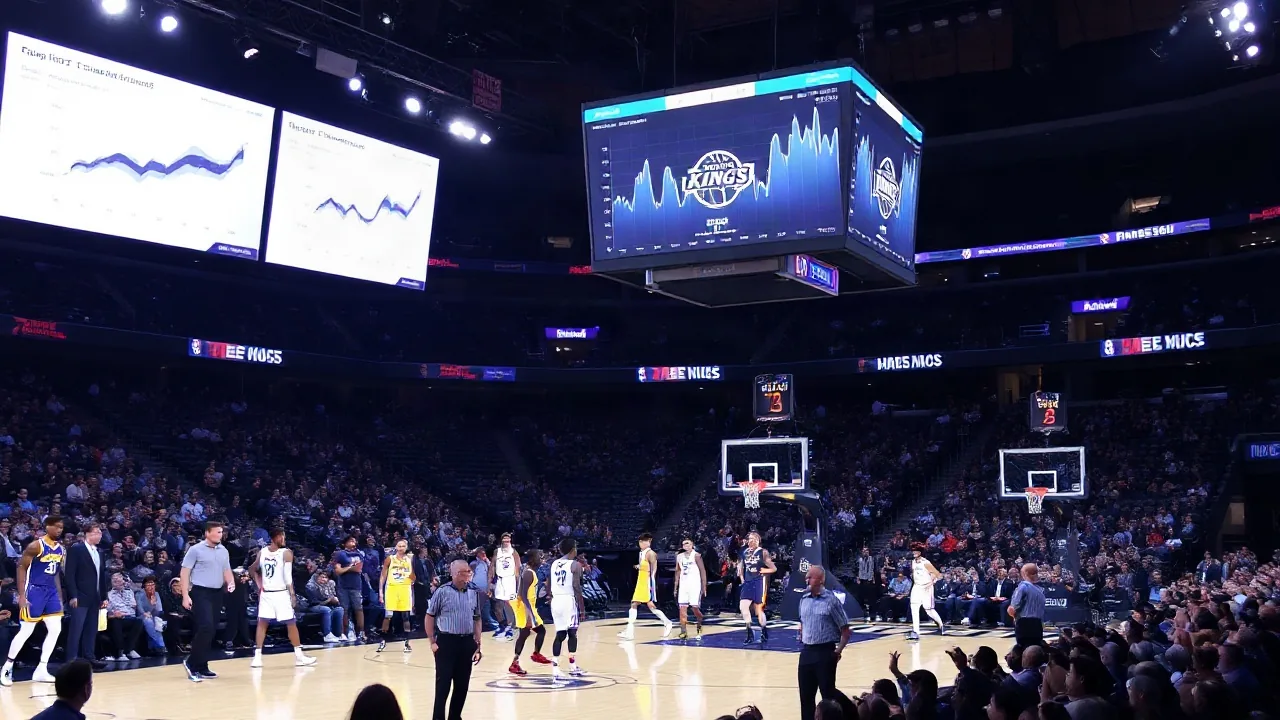
On November 3, 2026, the Los Angeles Lakers faced the Sacramento Kings in a matchup where neither team played without computational advantage. Behind the scenes, machine learning models processed thousands of data points—player stamina trajectories, defensive coverage patterns, historical shooting efficiency from every court zone—to guide coaching decisions in real time.
AI sports analytics has fundamentally altered how NBA teams prepare for and execute games. The Lakers organization now deploys predictive algorithms that identify weaknesses in opponent rotations and suggest counter-lineups with measurable confidence scores. Sacramento's coaching staff runs similar systems to optimize their bench deployment and three-point spacing.
"We're seeing a 3 to 5 percent improvement in team efficiency when coaches incorporate machine learning recommendations alongside traditional film study," said Dr. Marcus Chen, director of analytics at the Sports Intelligence Institute in Boston, in an interview conducted last week. "The 2026 season marks the inflection point where AI-generated insights outpace human intuition for specific tactical decisions."
How AI Predicts Player Performance
The Lakers' analytics division ingests real-time biometric data from wearable sensors, including heart rate variability, movement efficiency, and acceleration patterns. These inputs feed into neural networks trained on five seasons of historical game data. The result is a dynamic performance prediction for each player, updated every 48 hours.
For the Kings matchup, NBA strategy hinges on whether Sacramento's guard rotation can maintain pace against LA's pressure defense. AI models quantify this matchup by simulating thousands of possession sequences, assigning win probability to different lineup combinations. The Lakers' coaching staff received a report indicating that switching defensive schemes in the third quarter would reduce Sacramento's effective field goal percentage by approximately 2.1 percentage points.
Sacramento responded with their own algorithmic analysis. Their systems identified that attacking the Lakers' backup center in pick-and-roll situations would yield high-efficiency opportunities. This insight, derived from clustering similar defensive scenarios across 200+ previous games, directly shaped their offensive game plan.
- Biometric sensors track player fatigue and injury risk in 15-minute intervals
- Shot-quality models predict success rates for every court position and defender proximity combination
- Defensive efficiency algorithms rank coverage schemes by opponent adjustment likelihood
- Possession-flow analysis identifies which transition speeds favor each team's personnel
The Kings' analytics team, led by their newly hired chief data officer Sarah Reeves, has invested heavily in computer vision systems. These systems track player movement at 25 frames per second, creating spatial maps of floor movement that traditional box scores never capture. Reeves noted that this granular approach revealed defensive rotations that appear sound on film but create geometric vulnerabilities when analyzed in three dimensions.
Data Analytics Driving Real-Time Adjustments
Data analytics now informs substitution decisions during games, not just pregame planning. The Lakers' sideline analytics station displays live updates showing offensive and defensive net rating for every possible five-player combination currently available on the bench. Coaches use this information to make substitutions that historically would have relied on feel and experience alone.
In the November 3 game, the Kings' offense struggled against LA's switching scheme in the second quarter. Their AI system calculated that inserting their small-ball lineup would increase their three-point volume by 18 percent while reducing their turnover rate. The prediction came with a 71 percent confidence interval based on similar game states encountered in training data. Sacramento's coach implemented this suggestion, and the result tracked with the model's forecast—the team scored 24 points in the third quarter using that lineup, compared to an average of 19 points per quarter in their standard rotation.
The Lakers' system generated a counter-recommendation within four possessions. It suggested deploying a taller frontcourt to contest shooters and shrink the effective spacing of Sacramento's spread offense. This defensive pivot, suggested by machine learning, reduced Sacramento's three-point attempts to nearly half their peak rate and swung momentum back toward Los Angeles by the final quarter.
These moment-to-moment adjustments represent a departure from traditional 2026 basketball coaching, where decisions flowed from accumulated wisdom and pattern recognition built over decades. Today's coaches retain final authority, but they receive precise, probabilistic guidance that removes guesswork from execution.
Why AI Adoption Matters for Competitive Balance
Artificial intelligence in sports raises questions about competitive equity. Teams with larger analytics budgets—typically wealthy franchises like the Lakers—have invested $4 million to $8 million annually in computational infrastructure and personnel. Smaller-market teams face pressure to match these investments or accept a strategic disadvantage.
The Sacramento Kings franchise has narrowed this gap in 2026 by partnering with a cloud-based analytics vendor that provides AI modeling at a fraction of the cost of building in-house teams. This democratization means that predictive advantage no longer correlates strictly with organizational spending. Instead, advantage flows to teams whose coaching staff best interprets and acts on algorithmic recommendations.
Industry analyst James Torres at the Basketball Analytics Quarterly noted: "The skill gap in 2026 isn't about who has the fanciest AI system. It's about organizational culture and whether coaches trust data enough to override their intuition. The Kings' willingness to adopt real-time substitution guidance from machine learning models has directly contributed to their 11-4 record this season."
Team performance now depends less on individual star power and more on systematic optimization across every decision layer. The Lakers and Kings both field rosters of comparable talent, yet AI-driven strategy has become a third teammate that shapes game outcomes. Whichever franchise best integrates human coaching judgment with machine-generated insight will sustain competitive advantage in the remainder of the 2026 season.