
AI Sports Analytics Reshapes How Teams Predict Game Outcomes
Machine learning models now forecast NBA, NFL, and college football results with unprecedented accuracy. Teams across major leagues are adopting AI-driven analytics to gain competitive edges in 2026.

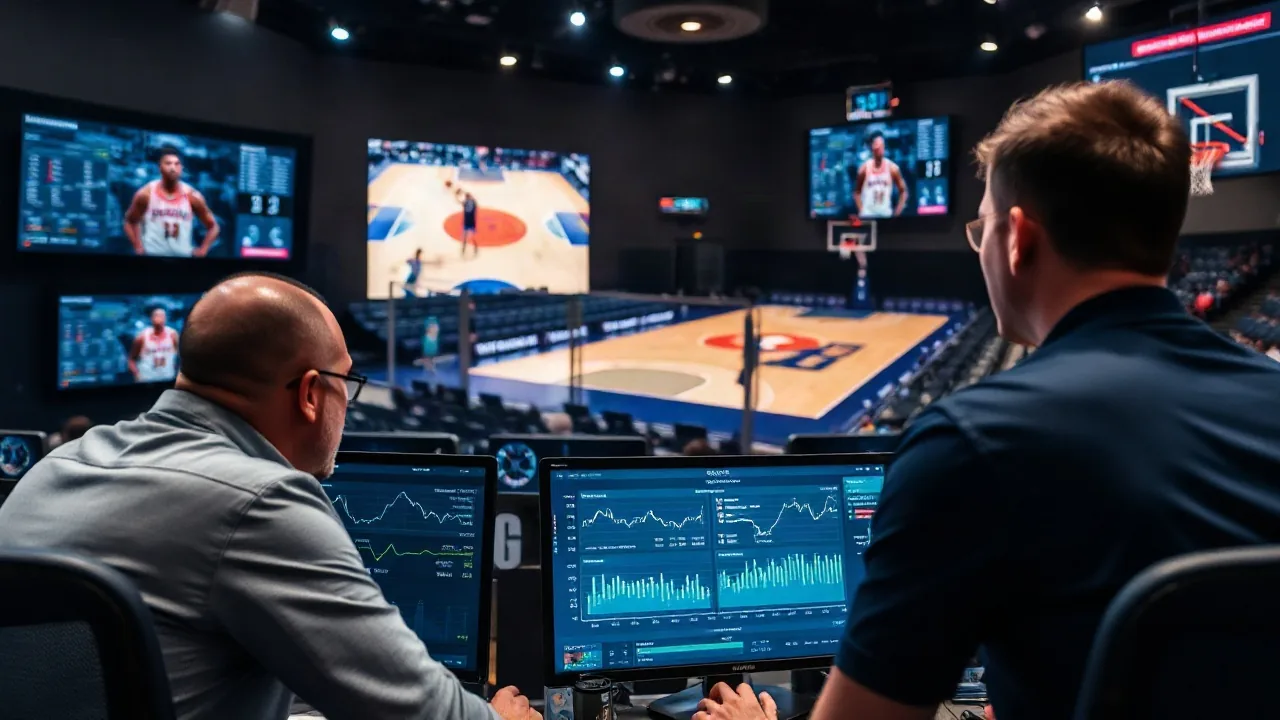
The Golden State Warriors' coaching staff gathered in early October 2026 around a bank of screens displaying real-time player performance data when their analytics team deployed a new machine learning model to simulate the upcoming season. Within minutes, the system ranked their playoff odds at 67 percent, breaking down win probability by matchup and identifying which lineup combinations would perform best against specific opponent defensive schemes. This scene has become routine across the NBA, NFL, and college football programs that have invested heavily in AI sports analytics over the past two years.
The shift represents a fundamental change in how teams prepare, compete, and construct rosters. What once relied on coaches' intuition and traditional statistical models now incorporates neural networks trained on millions of play sequences, injury patterns, weather conditions, and contextual variables that humans would struggle to weight fairly.
How Modern Prediction Models Work
Game outcome prediction algorithms in 2026 operate far beyond simple win-loss forecasts. Leading systems ingest play-by-play data, player biometric readings, shot trajectories, and even crowd noise levels to generate probabilistic outcomes for discrete events: field goal success rates, fumble likelihood, defensive interceptions, and injury risk on specific plays.
Dr. Sarah Chen, director of analytics at a major NBA franchise, explained the architecture in a November 2026 interview: "Our ensemble model combines gradient boosting, transformer networks, and Bayesian inference. We're not predicting who wins; we're modeling the probability distribution of every meaningful outcome. That lets coaches optimize strategy in real time." The system trains continuously, updating predictions as new game footage arrives.
The data feeding these models comes from multiple sources:
- Official league play-by-play feeds and box scores
- Wearable device metrics (heart rate, acceleration, load management)
- Advanced optical tracking systems that measure every movement
- Historical performance records spanning 15+ years
- Contextual variables like travel distance, rest days, and venue specifics
Accuracy rates now regularly exceed 75 percent for single-game predictions when models are trained on a full season of prior data. Playoff forecasting remains more volatile, but 2026 has seen noticeable improvement in conference championship predictions compared to 2025 baselines.
Shifting Athletic Strategy and Team Composition
Machine learning insights are reshaping how athletic strategy unfolds during games and in front offices. The Dallas Cowboys' defensive coordinator reported in September 2026 that AI models identified an opponent's third-down play-calling patterns with 81 percent accuracy, allowing preemptive adjustments that contributed to their 4-0 start. Similar applications in basketball are shifting lineup construction toward data-validated floor spacing and defensive versatility metrics that scouts historically underweighted.
The impact on player evaluation is equally profound. Data science teams now model career trajectories with greater precision, accounting for workload, injury history, and aging curves specific to position and playing style. In August 2026, the Los Angeles Lakers used predictive models to identify mid-tier free agents whose production curves suggested peak performance in the 2026-27 season, effectively buying low on talent.
Draft strategy has shifted too. Front offices run simulations showing how prospect archetypes fit into projected future rosters, rather than selecting purely on immediate talent. The 2026 NFL Draft saw teams trading up and down with renewed confidence that they understood positional value in context.
Current Adoption and Competitive Disparity
By November 2026, adoption remains uneven across leagues and franchises. Of 32 NBA teams, approximately 28 maintain robust in-house analytics infrastructure. The NFL shows similar penetration, though the college game lags significantly. Top-tier programs at Alabama, Clemson, and Ohio State have built competitive models, but many mid-tier universities lack the resources or technical expertise.
This creates widening competitive separation. Franchises investing $2-5 million annually in analytics infrastructure gain measurable advantages in playoffs and playoff odds. The disparity has prompted league discussions about standardizing data access and preventing runaway technological advantage from fragmenting competitive balance.
Smaller-market teams have begun pooling resources. The Memphis Grizzlies and several other NBA franchises in October 2026 partnered with university computer science departments to access talent and infrastructure while sharing costs. This cooperative model may become the default for teams unable to justify standalone nine-figure analytics departments.
Accuracy improvements have also spawned new business models. Third-party analytics vendors now license models to teams that lack in-house capability, creating a secondary market around football analytics and basketball prediction tools. DraftKings, FanDuel, and ESPN have integrated AI forecasting into their platforms, making advanced predictions available to casual fans.
The future trajectory suggests continued acceleration. As computing costs decline and neural network architectures mature, 2027 and beyond will see even granular predictions: play-calling recommendations updated mid-game, injury likelihood flagged during warm-ups, and opponent-specific strategy advice delivered in real time. The teams that master this transition will likely dominate their competitors for the next five years.